Locations · Dallas–Fort Worth
Enterprise IT lifecycle programmes for Dallas–Fort Worth, processed in Lewisville
Ten loading docks, a drive-in ramp and an eleven-hour receiving window inside the metroplex. Refreshes, rip-and-replace, network take-outs and data centre exits are executed on your sites and processed in our own 70,000 sq ft facility — one custody chain, one asset record, one certificate set.
The facility
A real address, which is a lower bar than it sounds
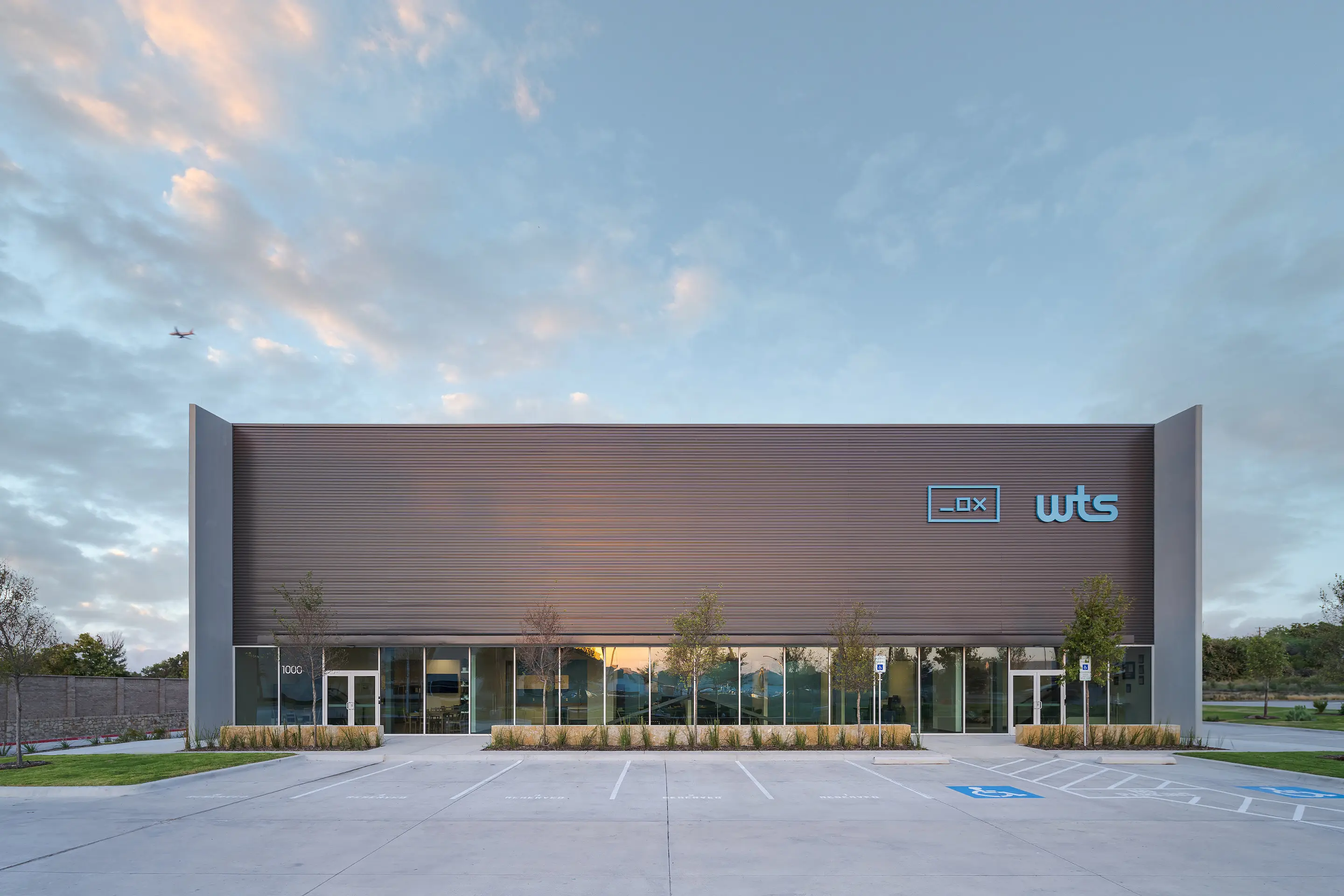
1000 Spinks Road, Suite 100, Lewisville, TX 75067. Denton County, on the I-35E corridor, close to DFW International Airport. It is our own building, operated under our own R2v3 and RIOS certified management system — not a shared warehouse, not a broker's mailing address, and not a subcontractor's floor that appears on somebody else's website too.
That distinction is worth making because the search you probably ran to get here returns a great many companies with a Dallas page and no Dallas facility. The test is simple and you should apply it to us as readily as to anyone else: ask where the assets are processed, then ask to see it.
What is on the floor
70,000 sq ft, and what each part of it is for
- 70,000 sq ft
- Secured processing facility
- Lewisville, Texas
- 37,000 sq ft
- Warehouse and racking
- Narrow-aisle, high-bay
- 1,500 pallets
- Storage capacity
- Climate controlled throughout
- 12,000 sq ft
- Mobile device processing
- High-density power delivery
Intake reconciliation, sanitization, functional testing, grading and mobile-device processing all happen on this floor, behind a single controlled entry and exit. The facility page covers the security model, the zone layout and what a walkthrough involves.
Project execution capacity
What it takes to absorb a project rather than meter it
A refresh, a rip-and-replace, a network take-out or a data centre exit does not arrive as a pallet. It arrives as trailers, on a schedule, often on the same day — and the constraint is almost never the processing. It is the dock.
- 10 docks
- Operating loading docks
- Supports parallel receiving for multi-trailer projects
- 8:00–7:00
- Receiving and operations window
- An eleven-hour day, so a crew finishing on site in the afternoon still delivers the same day
- Drive-in ramp
- Vehicles enter the warehouse
- Loading and unloading happen inside the building, under camera, not on an exterior apron
Ten docks is a scheduling fact before it is a capacity one. The dock face supports parallel receiving for multi-trailer projects, so an inbound schedule can be planned around the site's release dates rather than around our intake. Freight that can be brought to a dock is freight whose manifest can be reconciled as it comes off the vehicle, which is where the asset record either holds or does not.
The drive-in ramp moves the transfer point indoors. Vehicles come into the warehouse rather than backing onto an exterior apron, so custody passes inside the secured envelope and under camera. It also means equipment that is not dock height — box trucks, vans, rolling stock off a raised floor — is handled at grade instead of improvised with a liftgate.
The window matters at the end of a shift, not the start. Decommissioning crews finish when the work finishes. A receiving operation that closes mid-afternoon turns that into an overnight hold somewhere, which is a custody gap and a conversation you would rather not have. Eleven hours absorbs the day.
All three are booked. Deliveries and collections are scheduled against a manifest so the reconciliation happens at intake rather than afterwards — an unannounced arrival is the one case where the chain of custody genuinely starts weak, and it is the case we decline.
Multi-trailer project, a hand-back date, and a manifest that has to reconcile? That is the work this floor is arranged for.
Scope the scheduleWhy local matters here
Proximity is a custody argument, not a convenience one
Being nearby saves a little freight cost. That is not the point. The point is that every extra leg in the journey is another handoff whose record has to reconcile with ours.
- 01
One journey, not three
Assets go from your site to Lewisville. There is no regional depot in the middle, so there is no intermediate handoff whose paperwork has to be reconciled against ours later.
- 02
Same-metro witnessing
A DFW compliance officer can be on our floor the same morning. Witnessed destruction stops being a scheduled trip and becomes a meeting.
- 03
Short custody window
The fewer hours a data-bearing device spends in transit, the smaller the window you have to account for if anyone ever asks.
- 04
Audit without travel
Facility walkthroughs and records reviews are available by appointment. For a client inside the metroplex that is an afternoon rather than a flight.
If witnessed destruction is written into your policy, a processing floor inside the metroplex turns that from a logistics exercise into a standing arrangement.
Arrange a facility reviewProgramme coverage
Where we execute programmes across the metroplex
Named rather than mapped, and grouped by county because that is how multi-site estates in this metroplex are usually organized — an enterprise refresh rarely sits in one municipality. If your sites are not listed they are not excluded; ask.
Denton County
- Lewisville
- Flower Mound
- Denton
- The Colony
- Coppell
- Highland Village
- Corinth
- Little Elm
Collin County
- Plano
- Frisco
- Allen
- McKinney
- Richardson
- Wylie
Dallas County
- Dallas
- Irving
- Carrollton
- Garland
- Addison
- Farmers Branch
- Grand Prairie
- Mesquite
Tarrant County
- Fort Worth
- Arlington
- Grapevine
- Southlake
- Euless
- Bedford
- Hurst
Related services
What we deliver into the metroplex
Executed on your sites, processed at the Lewisville facility. De-installation, take-out and floor clearance happen where the estate is; everything after that happens here.
-
IT & Device Lifecycle Management
Procure, provision, deploy, support, refresh and recover, across the whole estate.
-
Asset Recovery & Remarketing
Value recovery on retired equipment, settled per serial.
-
IT Asset Disposition
Certified retirement of enterprise IT assets, processed in Lewisville.
-
Secure Data Destruction
NIST 800-88 sanitization with a certificate per serial.
-
Reverse Logistics
Collection across distributed sites and home-based staff.
-
Data Center Decommissioning
Sequenced exits across the DFW data centre corridors.
FAQ
Questions from Dallas–Fort Worth buyers
Where exactly is the facility?
Do you cover Fort Worth and the mid-cities as well as the Dallas side?
Can our own crew deliver the estate rather than us booking removal?
Can you take a multi-trailer project?
We have equipment that is not dock height. Is that a problem?
Can our compliance officer watch the destruction?
Do you work with data centres in the Richardson and Las Colinas corridors?
What size of estate is this arranged for?
What happens to the estate once it is here?
Scope your next refresh or infrastructure retirement.
Sites, estate, hand-back dates, and whether anyone needs to witness the destruction. We will come back with an execution schedule.